Bronson, Kreiss-Tomkins Split on Nuclear and Diesel at Fairbanks Energy Panel
Two of the four candidates for governor discussed rural power costs Thursday at the Alaska Rural Energy Conference.
By Jacob Reynolds ·
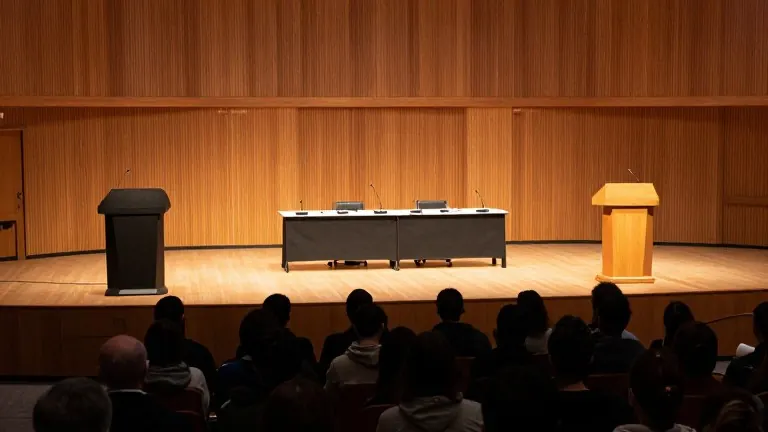
FAIRBANKS, Alaska: Two candidates for governor stood on a Fairbanks stage Thursday and described sharply different routes to powering rural Alaska, one leaning into nuclear generation and the other into efficiency measures and existing programs.
Democrat Jonathan Kreiss-Tomkins and Republican Dave Bronson, a former Anchorage mayor, took questions on the final panel of the Alaska Rural Energy Conference. The other two Republican candidates, Treg Taylor and Bernadette Wilson, did not attend, and the conference closed the same day.
The state's deferred maintenance bill sits at the center of the discussion. Bronson put the figure at nearly $300 million for older diesel generating equipment and about $1 billion for fuel storage. He proposed buying fuel in bulk for rural diesel users and building a 400-mile ice road on the Yukon River so trucks could deliver fuel in winter, which he called safer and cheaper than barging from the Lower 48. He said some communities pay $26 a gallon.
Kreiss-Tomkins framed the state's duty differently. He said the state must keep energy in rural Alaska reliable and affordable, calling that "the north star for what the state should be aiming to provide for our rural communities." He pledged to veto any legislative attempt to tap the Power Cost Equalization endowment, and he backed a statewide energy bond to help communities "get off diesel." He also raised heating fuel prices of $15 to $20 a gallon in some places, calling those levels economically existential for families there.
Both candidates defended the Power Cost Equalization program, which lowers electricity costs in rural areas. Bronson called for forward funding it and drawing federal dollars, while saying it cannot become a reason to skip building new generation and storage. "We have to do it because we simply can't abandon the rural towns," he said. Kreiss-Tomkins said he wants to look at equalizing heating fuel costs and has not settled on an approach. He also said recent $25,000 cash payments to a few villages were not a coherent policy response.
On infrastructure, Kreiss-Tomkins said the state needs institutions with technical expertise to rank need, and he called the Renewable Energy Fund's prioritization process and the Alaska Energy Authority's assessments reasonable work. He said he does not know whether state institutions can meet the challenges. Bronson said he would address villages facing the most immediate threat of failure, noting that some generators are older than the people who run them and that many fuel tanks are leaking. "It's time to saddle up and get this problem fixed," he said. He said he would keep using the Alaska Energy Authority rather than start a new department.
The candidates split on energy sources. Kreiss-Tomkins described an all-of-the-above approach that keeps Interior natural gas and coal in play, and he said diesel is not the long-term answer for villages. He also called himself pro-nuclear but said small modular reactor technology is not proven, pointing to the delayed Eielson Air Force Base pilot, and he said he has been in touch with Oklo, the company scheduled to install it. Bronson said small modular reactors power most large U.S. Navy capital ships and said, "The future of electrical generation in rural Alaska is nuclear. It just is." He also said he does not consider carbon dioxide a pollutant or a major driver of climate change. Kreiss-Tomkins called their disagreement on climate drivers a respectful difference of perspective.
A moderator noted the state spent more than $500 million on household weatherization after the 2008 oil price spike and that households saw costs drop nearly 25%. Both said they would prioritize weatherization now; Kreiss-Tomkins called it "a real slam dunk." On a closing question about a moonshot idea, Kreiss-Tomkins rejected the premise, describing a silver buckshot approach of many small changes across renewables, Power Cost Equalization, and protections for high-cost communities. Bronson answered, "It's do what we're doing now, just do it better in the near term," citing new generators and larger storage. He said his first years as governor would count as a success if villages facing generator failure receive new generators and larger fuel storage, and he pointed to his experience running Anchorage's $2 billion Port of Alaska project with the engineering firm Jacobs.
Source: KAUU