Mississippi's 23 public colleges face funding and enrollment scrutiny
A failed bill to merge community colleges has triggered a state-wide review of how 15 districts and eight universities sustain their operations.
By Jacob Reynolds ·
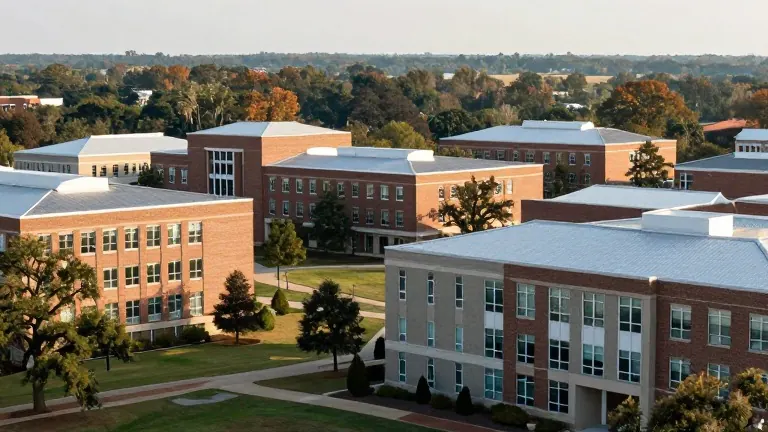
Mississippi operates 23 public colleges and universities, a number that legislators are currently questioning. The debate intensified after House Bill 1284, introduced in January, proposed merging six community college districts. The bill died in committee, but the underlying financial and demographic questions remain active in the state legislature.
Rep. Trey Lamar, a Republican from Senatobia, introduced the legislation to consolidate 15 community college districts down to 12. The plan paired Coahoma Community College with Mississippi Delta Community College, Meridian with East Mississippi, and Southwest Mississippi with Copiah-Lincoln. No campuses would have closed under the proposal. Lamar said the goal was to reduce administrative costs while returning savings to the community college system.
Population data supports the need for structural review. Census figures show Coahoma County lost 5,000 residents between 2010 and 2020, dropping from 26,000 to 21,000. Sunflower County, home to Mississippi Delta Community College, saw a decline of 4,000 residents over the same decade. These drops reduce the local tax base that funds local college boards.
The funding model for these institutions relies on a combination of state appropriations, federal funds, student tuition, and local tax revenue. Overlapping districts can result in property owners paying taxes to support multiple colleges. Lamar argued this creates an unfair burden. He cited Lauderdale County, which is served by both Meridian Community College and East Mississippi Community College, as an example of duplicative administrative costs.
Students reacted quickly to the merger proposal. Cole Cooksey, a sophomore in pre-political science at Southwest Community College, launched an online petition on January 23 to stop the bill. The petition gained 330 supporters on its first day and reached 750 signatures by the time the bill failed in committee. Cooksey said the move aimed to protect the state's oldest public college system and ensure rural students maintain affordable access to education.
Rep. Donnie Scoggin, a Republican from Ellisville, co-chairs the House Select Committee on Consolidation. He also chairs the House Colleges and Universities Committee. Scoggin said his committee killed the bill to allow more time for study. He stated the legislature wanted to avoid rushed decisions that might lead to closing colleges without sufficient analysis.
The scrutiny extends beyond community colleges to the state's eight public universities. Sen. Nicole Boyd, a Republican from Oxford, is pushing the Mississippi Institutions of Higher Learning to tie state funding to specific performance metrics. These metrics include graduation rates, job placement, and earnings. In June, trustees moved toward adopting a performance-based funding formula, though specific goals and an implementation timeline are still being defined.
Legislators have previously proposed more drastic measures. In 2024, Boyd introduced Senate Bill 2725, which would have created a task force to examine funding formulas in light of a predicted decline in high school graduates. That same year, former Sen. John Polk introduced Senate Bill 2726, which would have required the closure of three universities based on enrollment and retention outcomes.
The shrinking student pool threatens regional universities. Mississippi University for Women, Delta State, Alcorn, and Mississippi Valley State could face increased competition from the University of Mississippi and Mississippi State University for a smaller number of students. Pernell Goodwin, vice president of Copiah-Lincoln Community College’s Natchez campus, warned that consolidation could hurt rural access. He noted that longer travel distances would increase costs and make it harder for students to visit campuses.
Bruce Hanson, a former state representative and chair of the Citizens Coalition for MUW and Mississippi School for Mathematics and Science, opposes closing smaller institutions. He argues these schools provide affordable tuition and generate millions of dollars for the state economy. He said if these institutions disappear, local students will lose their primary option for higher education.
Source: ABC News