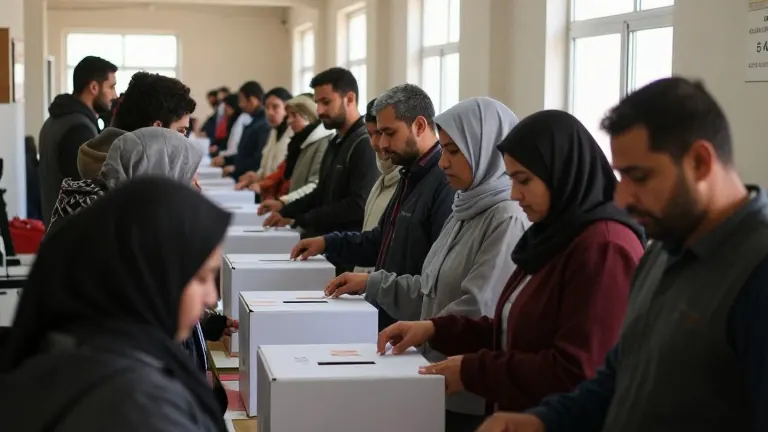
Israel Election Night: Leaders Define Victory Differently
With no clear parliamentary majority, party leaders used distinct demographic metrics to claim success in Tuesday's vote.
By Jacob Reynolds ·

No party or bloc secured a clear majority in the Israeli parliament following Tuesday's election, prompting leaders to define victory through specific demographic lenses rather than total seat counts. This approach allowed rival factions to claim success based on differing denominators of the electorate.
Benjamin Netanyahu declared victory by focusing on supporters of Israel as a Jewish state. In his election night speech, he stated, "Likud is the biggest party in Israel." He argued that the right-wing bloc holds a decisive majority among the Zionist and Jewish public, including those who support the Jewish character of the state. This calculation includes his coalition partners, Shas and United Torah Judaism, while excluding Arab parties.
Naftali Bennett and Gadi Eisenkot countered this claim by measuring the result through the lens of military conscription. Bennett stated, "The alliance of those who serve defeated the alliance of draft evaders." He pledged to form a Zionist government committed to universal service. Eisenkot echoed this view, asserting that Netanyahu now faces a stronger Zionist majority that demands shared burden in military service.
Yair Golan adopted the broadest definition, counting Arab parties alongside Jewish opposition parties to declare that the Israeli democratic majority had prevailed. Golan argued that Arab votes carry equal weight to Jewish votes and that the combined opposition forces formed the true majority against the outgoing coalition. This stance directly challenged Netanyahu's exclusion of Arab parties from his victory calculation.
Avigdor Liberman offered a distinct framing, appealing to the political tradition of the Zionist national camp. He urged those loyal to the paths of Trumpeldor, Jabotinsky, and Herzl to "raise the banner of revolt within Likud." Liberman positioned his appeal as a call to separate voter loyalty from loyalty to the prime minister, arguing that Netanyahu had betrayed the national Zionist path.
The conflicting definitions of victory reflect the lack of a unified parliamentary majority. The haredi parties, who resist conscription, support Israel's Jewish character, and thus fit within Netanyahu's definition but stand on the losing side of Bennett and Eisenkot's metrics. The immediate challenge for Israeli politics is determining whether these divergent interpretations of the electorate can be reconciled into a functioning government.
Source: The Jerusalem Post