
Record Arab turnout complicates Netanyahu's path
Palestinian citizens of Israel voted at rates above 70 percent in some towns, a shift that may block the prime minister from forming a majority coalition.
By Fiona Wallace ·
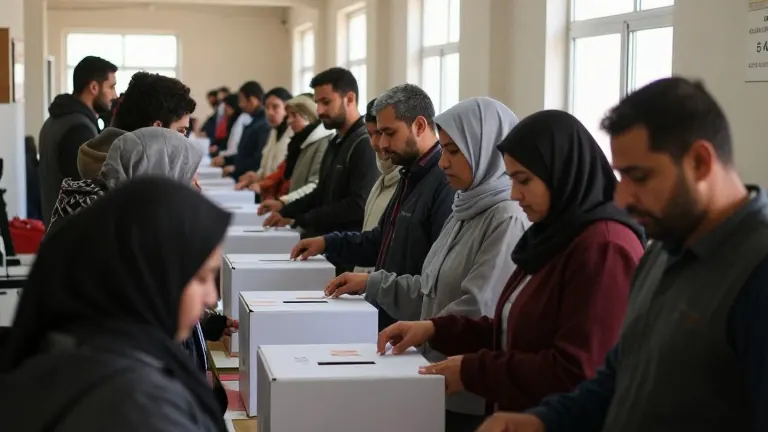
Palestinian citizens of Israel cast ballots at rates that defy historical norms, creating a potential obstacle for Prime Minister Benjamin Netanyahu. In several towns, participation exceeded 70 percent, a sharp departure from the 45 to 65 percent range typical of recent elections. This surge in voter engagement now threatens to prevent Netanyahu and his right-wing coalition from securing the 61-seat majority required to form a government.
The spike in turnout followed years of lower participation in Arab towns. Many residents who previously abstained viewed this election as a chance to challenge a government they perceive as hostile. Specific measures by the current administration fueled this motivation, including attempts by Jewish settlers to establish an outpost on Palestinian land in Majd al-Krum in the Upper Galilee. Hussein Manna, a resident of Majd al-Krum, said the situation provoked indifferent voters. "They know very well what awaits us if this government returns to power," Manna stated.
Netanyahu’s campaign, led by allies such as National Security Minister Itamar Ben-Gvir and Finance Minister Bezalel Smotrich, targeted Arab voters heavily. Preliminary reports indicate that the Joint List and the United Arab List (Ra’am) could secure up to 17 seats combined. Walid al-Omari, Al Jazeera’s bureau chief in Palestine, described the moment as fateful for Netanyahu’s political future and the identity of the state. He warned that a continued Netanyahu coalition would push Israel toward greater racism and extremism.
Ahmad Tibi, head of the Arab Movement for Renewal, stated that the primary goal is to bring down the government of Netanyahu, Smotrich, and Ben-Gvir. However, Tibi noted that leaders of other opposition parties have largely ruled out formal alliances with Arab parties. He called this stance a racist position linked to events after October 7. Tibi said the Arab parties are ready to cooperate to prevent Netanyahu from leading a transitional government. In exchange, they demand a government that addresses issues such as crime, violence, home demolitions, and the occupation.
Al-Omari outlined a potential coalition scenario where Gadi Eisenkot’s Yashar party wins 53 seats and Ra’am wins eight. This combination would yield the 61 members needed for a majority. During the campaign, Netanyahu posted AI-generated images of Arab voters, a move the Joint List called misleading. Mohannad Mustafa, an academic, argued that Netanyahu views the Arab vote as illegitimate. He linked this rhetoric to the 1995 assassination of Yitzhak Rabin, noting that Netanyahu had previously cited Rabin’s reliance on Arab lists as a reason for his opposition.
Right-wing activists deployed to polling stations in towns like Taibe, Tira, and Qalansawe were accused of obstructing the process. Tibi reported that these tactics aimed to create long queues to discourage voters. Instead, he observed a determination among the community to stay until voting was complete. The election outcome carries weight for the region, where Netanyahu has led military engagements in Gaza, Syria, Lebanon, and Iran. Analysts note that a new government might alter these military engagements, though Netanyahu bears responsibility for the security failure on October 7.
The next step involves the counting of remaining ballots and the formal announcement of seat allocations. Once the Knesset convenes, the Speaker will task the leader of the largest bloc with forming a government within a set deadline. If no coalition is formed, the president may appoint a different candidate or call for fresh elections. The final numbers will determine whether the opposition can unite to displace the current administration.
Source: Al Jazeera